“What inspired me is that my parents fought for me when I was very young. They wanted me to know that I was an individual, that we’re all individuals, that we’re all human beings and that we’re all connected together and that we all have the same rights; the same freedom.” — Sylvia Méndez
History is not only about the past. It shapes our present and influences our future. And when our education is limited, so is our understanding of how history continues to shape the world around us.
In school, we do not always learn the full history of the United States. We don’t always hear the stories of Indigenous men and women whose actions shaped this country, or of African American men and women who fought for equality and transformed American history. Likewise, the contributions of Latinos and Latinas have often been left out of the larger American story.
In the United States, we celebrate Hispanic or Latino Heritage month from September 15 to October 15. For me, being Latina is an honor, and this month gives me an opportunity to celebrate the lives and contributions of other Latina women whose courage and determination helped shape the history of our country. And I feel indebted to their sacrifices.
Women who chose to use their voices and their lives to challenge injustice. Latinas who refused to allow difficult circumstances to determine what they could accomplish.

In this first post, I would like to introduce you to Sylvia Méndez, a little girl who was told she didn’t belong.
This little girls would grow up to became a pioneer of the American civil rights movement.
In the 1940’s, Sylvia Méndez, was a little girl living with her family in Westminster, California.
Her parents, Gonzalo and Felícitas Méndez, wanted their children to attend public school near their home. But when they tried to enroll them, they were told that the children could not attend because of their Mexican heritage. Instead, they were told to go to a segregated school for Mexican children.
Can you imagine being a child and being told that you can not go to the school closest to your home because of your heritage?
Fortunately, Sylvia’s parents did not accept the answer. Instead, they decided to fight.
A family’s decision to stand up
In 1944, Sylvia’s parents, Gonzalo and Felícitas Méndez, joined with several other Mexican American Families to challenge the segregation of their children in California’s public schools. Their children were denied admission to a school designated for white students and were instead directed to a segregated school for Mexican American children.
The families filed a lawsuit against the Westminster School District and several other school districts in Orange County, California. Their case, Méndez v. Westminster, challenged the segregation of Mexican American children in the state’s public schools.
In 1947, the federal appellate court upheld the decision that segregation of Mexican American children in California’s public schools was unlawful. The case became an important milestone in the history of school desegregation and helped lay groundwork for the broader civil rights movement.
Seven later, the legal fight against school segregation continued to gain national attention. The landmark Brown vs. Board of Education decision in 1954 declared racial segregation in public schools unconstitutional.
This case became an important part of the history of school desecration in our nation. The Smithsonian describes it as a groundbreaking case in which Hispanic parents successfully challenged school segregation.
Sylvia’s story reminds us that the fight for civil rights did not begin with one case or one group of people. Many communities were fighting for equality in different places and in many ways.
Sylvia’s role in the story
When we talk about this story, it is important to remember that Sylvia was a child. Her parents were the ones who brought the lawsuit and led the legal fight.
Still Sylvia became an important part of the story because she was one of the children whose education was at the center of this case.
And she did not leave her story behind when she grew up.
After retiring as a pediatric nurse, Sylvia dedicated herself to sharing her family’s story and educating others about discrimination, equality, and the importance of education.
Her story became part of the history she once had to live.
A legacy recognized

In 2011, President Barack Obama awarded Sylvia Méndez the Presidential Medal of Freedom, the highest civilian honor in the United States.
During the ceremony, President Obama described how she had been denied entry into a public school because of her heritage and recognized her important role in the struggle against segregation.
Bur perhaps one of the most powerful parts of Sylvia’s legacy is that she continues to tell her story. She travels and speaks with students, encouraging them to understand their history, value their education, and recognize their own ability to make a difference.
Sylvia Méndez has spent decades sharing and teaching students about the importance of standing up against injustice. She has spoken about the lessons her parents have taught her. She says she learned,
“That we are all individuals; that we are all human beings; that we are all connected to each other; and that we all have the same rights, the same freedom.”
Why Sylvia’s story matters
Sylvia Méndez’s story reminds us that history can begin with a personal experience. Many children today can go to public schools without ever having to wonder whether they will be allowed through the doors because of their ethnicity. Sylvia’s story reminds us that people fought for this freedom. People like her parents and the other families that stood with them.
And people like Sylvia Méndez, who spens her life making sure that we remember this history.
As a Latina, I believe these stories deserved to be shared and recognized.
Not only during Hispanic Heritage Month.
Not only in history books. But as part of the American story.
Latina history is American history.
What can we do?
Learning someone’s story is a beginning, but we can also help keep that story alive.
Share Sylvia’s story.
One way to do that is through books. If you have children, grandchildren, students, or young people in your life, consider introducing them to Sylvia Méndez through children’s literature.
Separate Is Never Equal: Sylvia Méndez and Her Family’s Fight for Desegregation by Duncan Tonatiuh tells Sylvia’s story and the Méndez family’s fight against school segregation.
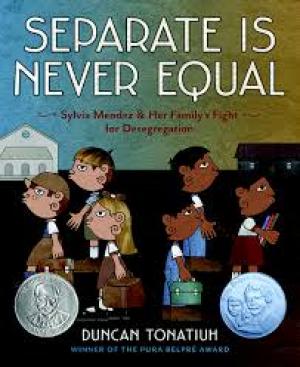
Read the book together.
Talk about it and ask questions like: What would you have done if you were Sylvia?
Or, what does it mean to stand up when something isn’t fair or just?
And, what can we do today when we see someone being treated differently because of who they are or where they were born?
Remembering history isn’t just about knowing what happened.
It can also be about helping the next generation understand why it mattered.
And perhaps most importantly, it is about giving others the courage to recognize when their own voices can make a difference.
Stay tuned to the next word…